Every alert, every suspicious domain, and every flagged executable competes for attention in an environment in which time is the most constrained resource. A detection on its own rarely answers the question that actually matters: Does this require action right now or not? The difference between signal and noise is rarely volume—it is context, really.
That is where cyber threat intelligence (CTI) becomes operationally meaningful, as the layer that explains relevance, connects patterns, and allows teams to decide what deserves urgency. That becomes even more critical in the gray areas of modern attacks, in which tooling looks legitimate and intent is deliberately obscured.
Although this article begins with the day to day reality of security operations, threat intelligence ultimately informs decisions far beyond the Security Operations Center (SOC)—from risk management and architecture to leadership-level investment and strategy.
Key points of this article:
- Cyber threat intelligence is about adding context to the data that turns signals into decisions across security workflows.
- Raw indicators become useful intelligence only when enriched with relevance, confidence, and links to real attacker behavior and campaigns.
- Effective CTI operates across parallel decision layers, from analysts and threat hunters to leadership, supporting both operational response and strategic risk management.
- The most challenging threats often emerge in the gray zone, in which legitimate tools are abused and traditional detection struggles without contextual intelligence.
- Going beyond ransomware group names, affiliate-level ESET eCrime intelligence provides insight into how attacks truly unfold and how to stop them early.
- Intelligence only creates value when it integrates into existing systems and workflows, enabling faster, more confident decisions rather than adding noise.
What is CTI?
A raw indicator—a hash, a domain, an IP address—is simply an observation. It tells you something happened. Intelligence, by contrast, tells you what that observation means in context: whether it is part of an active campaign, whether it aligns with known attacker behavior, and whether it intersects with your environment.
That distinction sounds simple, but it breaks down quickly in practice. Most security teams already ingest multiple feeds, many of them high volume and low context. Without enrichment, those indicators become a liability. They require manual triage, introduce ambiguity, and slow response down rather than accelerating it.
Modern CTI emerges precisely at that intersection. It connects indicators of compromise (IoC) with tactics, techniques, and procedures (TTPs); attribution signals; infrastructure patterns; and confidence scoring. Only then can an analyst move from noting something was flagged to explaining what about it matters, why it matters, and what to do next.
Why CTI matters to security teams
At a practical level, CTI is a prioritization engine. A SOC isn’t trying to understand all threats. It is trying to understand which ones are relevant now, in the context of its assets, geography, and exposure. Without that filtering layer, analysts are forced into reactive triage, which becomes the bottleneck at scale.
From more indicators to better decisions
This is where the industry often gets it wrong. The assumption has been that more data leads to better detection. In reality, more data usually leads to more indecision, and analysts end up asking the same questions repeatedly:
- Is this indicator tied to a real campaign or a one off artifact?
- Does it map to behavior we should already expect?
- Is it relevant to anything we have running?
CTI exists to answer those questions, and more, way before the analyst ever sees the alert itself.
Who uses CTI?
Answering such questions is beneficial for multiple audiences at once. On the front lines, analysts rely on CTI to validate alerts and understand whether an isolated signal is part of a broader pattern. Threat hunters use the same intelligence differently, forming hypotheses about attacker behavior and searching for evidence of those patterns in the environment.
Further along the chain, detection engineers translate CTI into controls, turning observed techniques into rules, queries, and automated detections that scale across the security stack. At the operational level, SOC leads and incident responders use campaign context to prioritize investigations and anticipate attacker movement.
Outside the SOC, the role of CTI continues. Vulnerability and exposure management teams use CTI to prioritize remediation based on real-world exploitation, while security architects and leadership use it to align controls and investment with the threats that matter. At the executive level, strategic CTI provides the context needed to translate technical activity into business risk.
The three types of cyber threat intelligence
The traditional split into tactical, operational, and strategic CTI is often misunderstood as a progression, a sort of “maturity curve.” It isn’t because these types of CTI are simply different lenses applied to the same underlying reality.
First, tactical CTI focuses on immediate detection: indicators, signatures, and mappings to known techniques. It answers this question: What should we look for right now?
Second, operational CTI steps back and takes a firm look at campaigns, connecting activity into narratives: how an intrusion unfolds, which infrastructure is reused, and how tooling evolves. It answers this question: How is this attack actually happening?
Finally, strategic CTI moves further out. It looks at patterns across regions, industries, and geopolitical drivers. It answers this question: What does this mean for our risk profile?
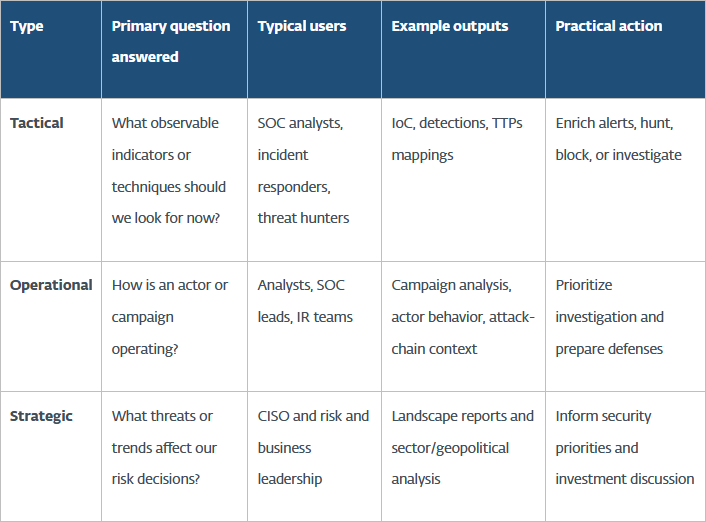
In a functioning SOC, all three operate simultaneously, informing different levels of detail.
How the threat intelligence life cycle works
CTI is often described as a sequence: Define requirements, collect data, analyze and contextualize, disseminate findings, act, and use feedback to refine the next intelligence requirement.
In reality, it behaves much more like a feedback loop.
- Set intelligence requirements: Start with assets, risks, and questions instead of feeds or tools.
- Collect relevant threat data: From internal telemetry, external reporting, intelligence feeds, information‑sharing communities, and OSINT.
- Process and analyze for context: Correlate indicators with confidence, actor behavior, TTPs, and organizational relevance; reference MITRE ATT&CK as common language.
- Disseminate and operationalize: Ensure intelligence reaches the relevant analyst, leader, or security system in usable form.
- Act, review, and refine: Assess whether intelligence answered the original question; refine future collection and improve your approach.
This cycle is far from theoretical. Organizations that adopt a prevention-first mindset use CTI to anticipate attacks and inform decisions before incidents escalate. The output feeds back into the environment, which is an important part of the process.
Enriched CTI improves detections. Better detections produce better telemetry, and better telemetry sharpens the next round of analysis. It is like a flywheel, continuously increasing in value as it spins.
CTI sources, feeds, and standards
Many organizations encounter CTI as feeds, which means they see it as streams of indicators delivered in machine readable formats. In fact, feeds are necessary, but they aren’t sufficient.
What do intelligence feeds provide?
Without curation, intelligence feeds introduce the same problem they are meant to solve: too much data with too little meaning. What differentiates useful CTI is how that data is filtered, enriched, and delivered.
In practice, a CTI feed should provide relevant, high-confidence indicators that have been deduplicated and validated, reducing manual triage. It should also add context, linking indicators to campaigns, infrastructure, or attacker techniques so analysts understand why something matters instead of just saying it was observed.
The goal is to help analysts decide faster and reduce the need for decision-making because high-confidence signals are already validated.
Prioritization is equally crucial. Indicators vary in importance, and confidence, while severity scoring helps teams decide what requires immediate action versus monitoring. Finally, intelligence must be usable within existing workflows and delivered in standardized formats such as STIX and TAXII so it can integrate directly into SIEM, SOAR, or TIP platforms.
What do STIX and TAXII mean
Standards such as STIX and TAXII play a critical role in making CTI usable at scale. STIX defines how threat information is structured, representing indicators, relationships, and context in a consistent format, while TAXII defines how that information is shared between systems.
In practice, they allow intelligence to flow directly into SIEM, SOAR, and CTI platforms without manual handling, ensuring consistent ingestion and automation across the security stack.
However, such standardization alone isn’t enough. Intelligence only becomes valuable when it fits into existing workflows, reaching analysts and systems in a form they can act on immediately.
Where good intelligence comes from
“Good intelligence doesn’t ask the SOC to come to it; it goes where the SOC already is. … If you’re an intelligence provider, you shouldn’t compete with what a SIEM, TIP, or SOAR already does. If you already generate valuable intelligence, you should, in fact, be able to integrate with them all instead, which is exactly what ESET does.”
— Wolf Schumacher, Vice President of Global Partnerships and Alliances at ESET
That idea sounds obvious, but it highlights a real failure mode in the market: Intelligence that exists in its own interface requires its own analysis and ultimately competes with the tools analysts already rely on.
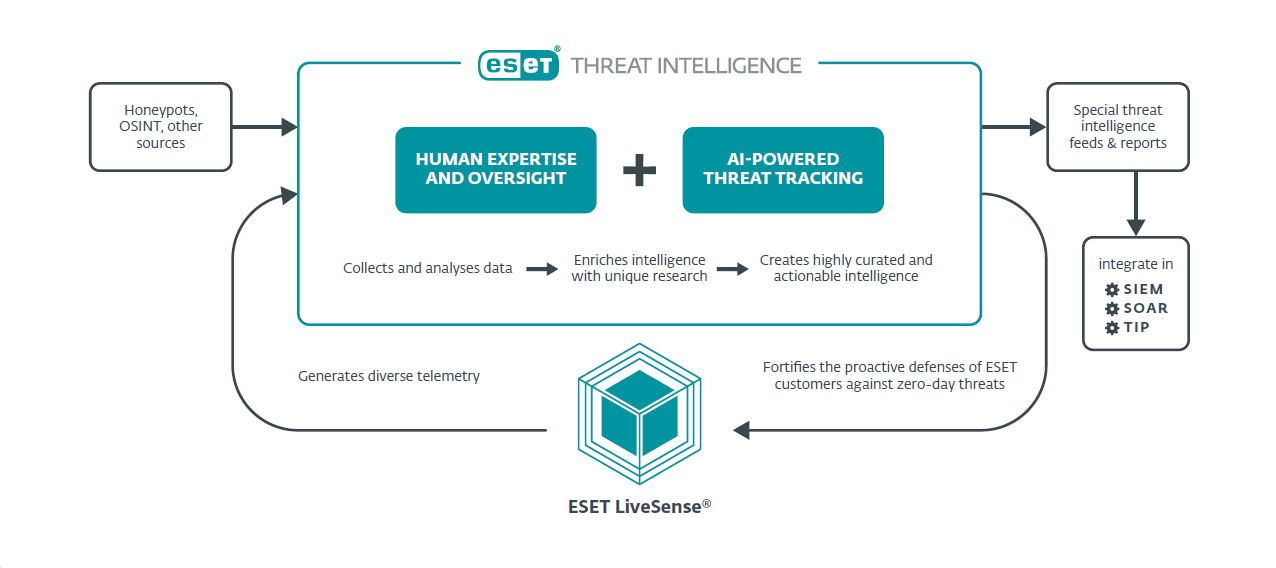
ESET Threat Intelligence (ETI) reflects that expectation. ETI is delivered in STIX 2.1 and JSON formats via TAXII and integrates directly into platforms such as Microsoft Sentinel, Elastic, OpenCTI, and ThreatQuotient, allowing teams to consume it inside existing workflows rather than alongside them.
At that point, CTI stops competing with the SOC’s workflow and starts strengthening it. It becomes embedded in the tools analysts already rely on thanks to reducing friction, improving context and turning signals into decisions in real time.
How SOC teams use cyber threat intelligence
The value of intelligence becomes clear only when it is applied to the following.
Alert enrichment and triage
At the most immediate level, CTI enriches alerts with context that raw detections lack. A suspicious event becomes actionable when it is linked to known infrastructure, attacker behavior, or campaign activity.
This context reduces ambiguity, allowing analysts to assess relevance and urgency faster. Instead of treating alerts in isolation, teams can prioritize based on real threat patterns rather than assumptions.
Threat hunting and incidence response
In threat hunting, intelligence provides direction. Rather than exploring blindly, hunters can focus on specific techniques, tools, or infrastructure associated with active campaigns, significantly increasing the likelihood of meaningful findings.
In incident response, intelligence adds narrative depth—revealing how an attacker typically moves, persists, or escalates access—and helps teams to scope incidents accurately and avoid missing critical stages of compromise.
SIEM, SOAR, XDR, and TIP workflows
Threat intelligence increasingly operates at a system level. SIEM, SOAR, and XDR platforms ingest intelligence feeds to enrich events, trigger automated playbooks, and improve correlation across data sources.
When properly integrated, intelligence enhances detection logic and response speed, enabling consistent decision-making at scale that brings the huge benefit of avoiding laborious manual analysis.
Relevance, context, and workflow integration
These use cases only work when intelligence is specific and operationally aligned. Generic or low-context data creates noise and slows teams down. Effective CTI must reflect the organization’s environment, include meaningful context, and integrate seamlessly into existing workflows. When those conditions are met, intelligence becomes part of the decision process itself.
The gray zone: Where most attacks begin
There is a part of the threat landscape that doesn’t fit neatly into “malicious” or “benign.” This is the gray zone where many modern intrusions take root, and most of the industry handles it poorly or ignores it.
Potentially unwanted applications (PUAs), remote management tools, and legitimate utilities fall into this category. They aren’t inherently malicious, and in many environments, they’re necessary. But they’re also routinely abused.
Remote management platforms, in particular, illustrate the problem perfectly. They enable both administration and, unfortunately, unauthorized access. They facilitate maintenance but also lateral movement. From a detection standpoint, distinguishing legitimate use from malicious use is extremely difficult. Most detection tools struggle here because the behavior doesn’t look anomalous. It looks normal, just in the wrong context.
Effective CTI addresses that gap by focusing on context over classification. It tracks how these tools are used in real attacks, correlates them with known intrusion patterns, and highlights when they appear in suspicious conditions.
ESET’s long-term tracking of PUAs, spanning decades of classification and analysis, is an example of how this depth builds over time. It allows defenders to identify when a legitimate tool is part of a known abuse pattern, often before more overtly malicious activity appears. In many cases, that becomes the earliest reliable signal that something is wrong.
Beyond ransomware brands: Understanding affiliates
Another area in which traditional intelligence falls short is in how it frames adversaries. Most ransomware reporting centers on group names: RansomHub, Embargo, Gentlemen, and many others. However, those names represent whole ecosystems. The actual attacks are often carried out by affiliates, independent actors who choose their own tools, infrastructure, and targets. This distinction matters because affiliates persist even when ransomware brands don’t.
Related reading: Democratization of cybercrime: Understanding MaaS and infostealers
If intelligence focuses only on named groups, it loses continuity when those groups rebrand or dissolve. If it focuses on affiliates—their behavior, tooling, infrastructure—it retains visibility across those shifts.
ESET’s eCrime reporting explicitly takes that approach, clustering activity at the affiliate level and mapping behavioral patterns that persist across campaigns, tooling, and infrastructure. Rather than focusing on ransomware brands or leak sites, it reconstructs how real intrusions unfold, from initial access to data exfiltration, using insights drawn from live incidents and telemetry.
This affiliate-focused perspective remains one of the least developed areas in mainstream CTI, despite reflecting how attacks occur in practice.
For defenders, that shifts intelligence from descriptive to operational. It allows teams to recognize recurring attack patterns earlier, even before clear attribution emerges, and to anticipate how an intrusion is likely to progress while giving them a critical window to act before impact escalates.
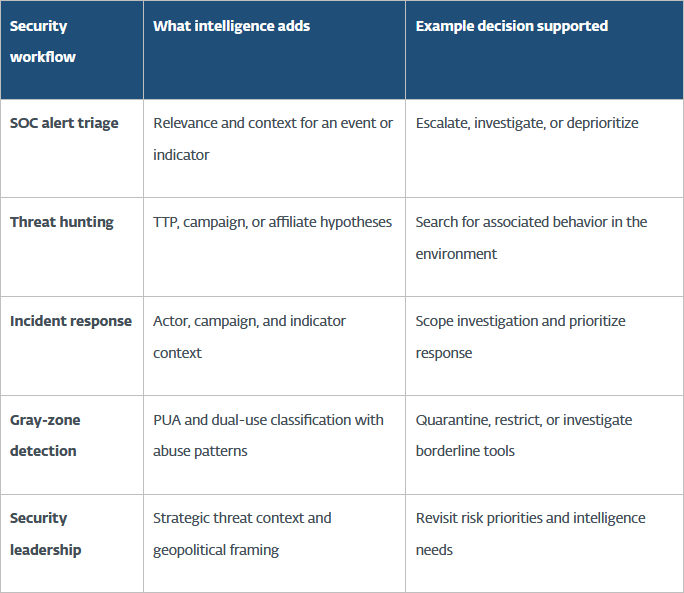
CTI only creates value when it supports concrete decisions. The table below shows how intelligence maps directly to common security workflows and the types of decisions those workflows require.
“This is why behind-the-scenes work matters so much: the heavy lifting of processing, enriching, correlating, clustering, and dissecting the samples that appear in telemetry—when threat intelligence is supported by long-term research and disciplined analysis, indicators stop being dots on a page and start becoming patterns. Patterns that help SOC teams make decisions with speed and confidence.”
— Jean-Ian Boutin, Director of Threat Research, ESET
Cyber threat intelligence vs. feeds, threat hunting, SIEM, and TIPs
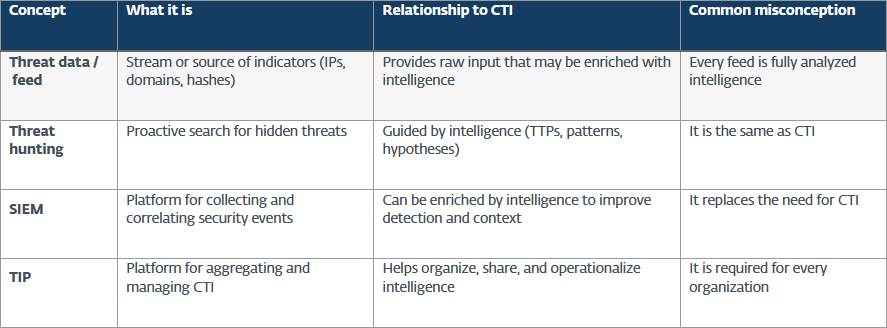
CTI is often discussed alongside feeds, platforms, and security operations activities, but these terms aren’t interchangeable. Confusing them leads to unrealistic expectations while assuming, for example, that a feed delivers fully contextualized insight or that an SIEM replaces analysis. In practice, each plays a distinct role in how security teams detect, understand, and respond to threats.
CTI itself is the contextual layer used for decision-making. It draws from multiple inputs, including feeds and telemetry, and is applied across workflows such as detection, hunting, and incident response. The distinction matters: Without clarity, organizations risk investing in tools or data streams that don’t solve the problem they face.
The table below outlines how these concepts relate to CTI and how they function together in real-world security operations.
How to assess whether threat intelligence is useful for your organization
The right question is whether threat data can be turned into intelligence that answers real questions and supports day-to-day decisions. Start by evaluating whether intelligence reflects your actual risk profile. That includes the industries, regions, and types of adversaries most relevant to your environment. Intelligence that is broad but generic often fails to translate into action.
Equally important is context. Indicators alone are rarely sufficient; they need to be enriched with confidence scoring, behavioral insight, and links to attacker activity. Without that, analysts are left doing the interpretation themselves, which slows response and increases uncertainty.
Finally, assess how intelligence fits into your workflow. If it requires separate tools or manual handling, it is unlikely to be used consistently. In practice, organizations often struggle to operationalize CTI, with many unable to integrate it into workflows or extract actionable insight despite consuming multiple feeds. CTI that can’t be applied early through integration, validation, or automation typically remains underused or ignored.
Checklist: Questions to ask
- Which assets, regions, sectors, or threat actors matter to the organization?
- Does the intelligence cover the environments we actually run—including Operational Technology (OT), and legacy systems—or just modern endpoints?
- Does it provide context, confidence scoring, and relevant TTPs, or strictly raw IoCs?
- Can analysts and systems consume it within existing workflows (STIX/TAXII, SIEM, SOAR, TIP integrations)?
- Is reporting useful for both operational teams and leadership?
- Will the vendor support a trial or a proof of concept to make sure the intelligence works for us?
How ESET Threat Intelligence (ETI) supports informed security decisions
ETI is designed to provide both the data and the context needed to support operational and strategic decisions across the organization.
Key differentiators include the following:
Geopolitical circumstances
Strong visibility in regions such as China, North Korea, Russia, and Iran provides earlier insight into emerging threats. This advantage is reinforced by ESET’s deep roots in Central and Eastern Europe—a region where a significant share of attacker infrastructure and activity originates—allowing closer, firsthand understanding of adversary behavior.
Affiliate-level eCrime intelligence
Instead of focusing only on ransomware groups, ESET analyzes the affiliates behind attacks, enabling earlier detection of behavioral patterns.
Gray-zone PUA
Dedicated feeds track legitimate tools frequently abused by attackers, addressing a commonly overlooked detection gap.
Standards-based integrations
Intelligence is delivered in STIX 2.1 and JSON via TAXII, with integrations into platforms such as Microsoft Sentinel, Elastic, OpenCTI, and ThreatQuotient.
AI-assisted analysis and decision support
ESET extends its ETI with AI-driven analysis through ESET Live AI*. By combining large language models with curated CTI for ESET APT Reports and WeLiveSecurity research, ESET Live AI can answer analyst queries and provide rapid insight into advanced APT campaigns.
This allows security teams to move from raw intelligence to actionable understanding almost instantly. By providing contextual explanations grounded in verified data, AI reduces the effort required to interpret complex research and helps accelerate both investigation and response.
Curated, multisource intelligence feeds built for action
ETI is delivered through a broad portfolio of specialized feeds and reports covering everything from ransomware, botnets, and phishing infrastructure to dual use applications and eCrime or APT activity. This breadth allows organizations to build a more complete picture of attacker behavior across multiple layers of the environment.
Real-time visibility
What differentiates ETI is its quality and timeliness. Indicators are continuously updated based on global telemetry and research, enabling near real time visibility into emerging threats. At the same time, data is carefully filtered, deduplicated, and enriched before delivery, ensuring that analysts receive only high confidence, relevant intelligence rather than redundant or low value signals.
This reduces noise but, more importantly, increases trust in the output itself. Instead of forcing analysts to validate or reinterpret every signal, ESET’s approach is designed so that what is flagged can be acted on with high confidence, significantly minimizing the need for triage and allowing teams to focus on response rather than verification.
Long-term stability and independence
A privately held, long-standing company structure provides predictability for organizations concerned about vendor risk.
ESET PRIVATE: Unique intelligence for the most complex environments
In complex enterprise-scale environments, including large companies, governmental organizations, and critical infrastructure, our customers consider threat intelligence essential. With CTI directly embedded into SOC operations, it enables continuous threat monitoring, faster incident response, and localized decision-making. Since threats are specific, defense must be as well.
Thus, beyond its intelligence feeds and reporting, ESET also provides customized CTI within its ESET PRIVATE offering. ESET PRIVATE Threat Intelligence supplies unique geopolitical and sector-specific context tailored to one’s own environment, combining early warning, monitoring, and exclusive research delivered as part of a strategic service partnership to better accommodate a client’s individual digital conditions.
Closing perspective
CTI is often framed as an information problem. Practically speaking, it’s a decision problem that only gets more complex as environments grow and attackers adapt.
The difference between organizations that extract value from CTI and those that don’t is rarely access to data. It is whether that intelligence can be applied consistently across workflows, from alert triage and threat hunting to vulnerability prioritization and strategic planning. That requires more than feeds: It requires context, integration, and the ability to translate observations into decisions at every level of the organization.
As this blog shows, CTI only becomes effective when it fits the environment it is meant to protect. It must reflect real threats, integrate into existing systems, and support both operational and strategic use cases.
Organizations that treat CTI as a stream of indicators will continue to struggle with noise. Those that treat it as a decision-support capability, embedded across systems, teams, and processes, will find it one of the few parts of their security stack that consistently reduces complexity rather than adding to it.
*Formerly named ESET AI Advisor
FAQ
What is CTI?
Cyber threat intelligence (CTI) is analyzed and contextualized information about threats that helps organizations make security decisions. Unlike raw indicators, CTI explains relevance: how an activity connects to attacker behavior, campaigns, and the organization’s environment. Its primary role is to turn signals into actionable insight, allowing teams to decide what matters and how to respond in time.
What are the three types of CTI?
Cyber threat intelligence is commonly grouped into tactical, operational, and strategic intelligence. Tactical intelligence supports detection and investigation with indicators and TTPs. Operational intelligence explains campaigns and attacker behavior. Strategic intelligence provides a broader view of risks and trends. These are not stages of maturity but, rather, parallel decision layers used simultaneously across different roles.
What is the difference between threat data and threat intelligence?
Threat data is a raw observation, such as a suspicious IP address, domain, or file hash. Threat intelligence adds context to that data by linking it to campaigns, attacker behavior, and confidence levels. With that context, security teams can decide whether an event matters. Without it, indicators remain isolated signals that increase workload without improving understanding.
How do SOC teams use CTI?
SOC teams use cyber threat intelligence to enrich alerts, prioritize investigations, guide threat hunting, and support incident response. CTI also feeds directly into security platforms such as SIEM, SOAR, and XDR to automate enrichment and decision-making. When integrated properly, CTI helps analysts focus on relevant threats instead of manually validating large volumes of low-context data.
What is the difference between threat intelligence and threat hunting?
Threat intelligence provides context about likely threats, attacker behavior, and techniques, while threat hunting is the active process of searching for evidence of those threats in the environment. Intelligence guides hunting by narrowing the search space and providing hypotheses, but it does not replace the investigation itself.
Can CTI integrate with SIEM tools?
Yes, cyber threat intelligence integrates with SIEM, SOAR, and TIP platforms through standards such as STIX and TAXII, as well as native connectors. This allows intelligence to enrich events, improve correlation, and trigger automated responses. When delivered directly into existing workflows, cyber threat intelligence becomes part of the detection and response process rather than a separate data source.
What is the “gray zone” CTI?
The gray zone refers to tools and activity that are neither clearly malicious nor clearly benign, such as remote management tools or potentially unwanted applications. Attackers frequently abuse these tools, making detection difficult. CTI helps reduce this ambiguity by providing context, linking usage patterns to known intrusion behavior, and identifying early-stage signals of compromise.
How is affiliate-level eCrime intelligence different from ransomware group analysis?
Traditional reporting focuses on ransomware group names, but actual attacks are carried out by affiliates, who are independent operators who reuse tools and infrastructure across campaigns. Affiliate-level intelligence tracks these patterns, allowing defenders to recognize attacks earlier, even when groups rebrand. This provides more consistent visibility into how intrusions unfold and how they can be stopped.