
It’s Monday, 10 a.m. The weekend fog has finally lifted. Blue- and white-collar workers are settling into the rhythm of the day, their keyboard click-clacks blending with the low rumble of trams carrying hundreds of people beneath the office windows. The city is awake, moving, functioning.
Then everything stops.
Screens go dark. Keyboards fall silent. Trams screech to a halt.
Phones come out. Emergency alerts follow: The local electricity distributor has suffered a major cyberattack, knocking out a third of the county’s grid. Estimated time to recovery? Not even the operator’s cybersecurity team knows. Their controls are crippled, and the backups are gone, too. With stronger isolation (air-gapping included), the outcome might have looked very different.
Key points of this article:
- Air gaps can keep critical systems out of attackers’ reach, but only when isolation is designed with the real world in mind.
- Physical air gaps reduce exposure, but do not make a system untouchable.
- Stuxnet, TRITON, and GoldenJackal show how adversaries use compromised people, malicious USBs, and weak processes to bridge air gaps.
- For critical infrastructure, the real value of air gapping comes from layering isolation with secure transfers, offline protection, and tested recovery.
What is an air gap in cybersecurity?
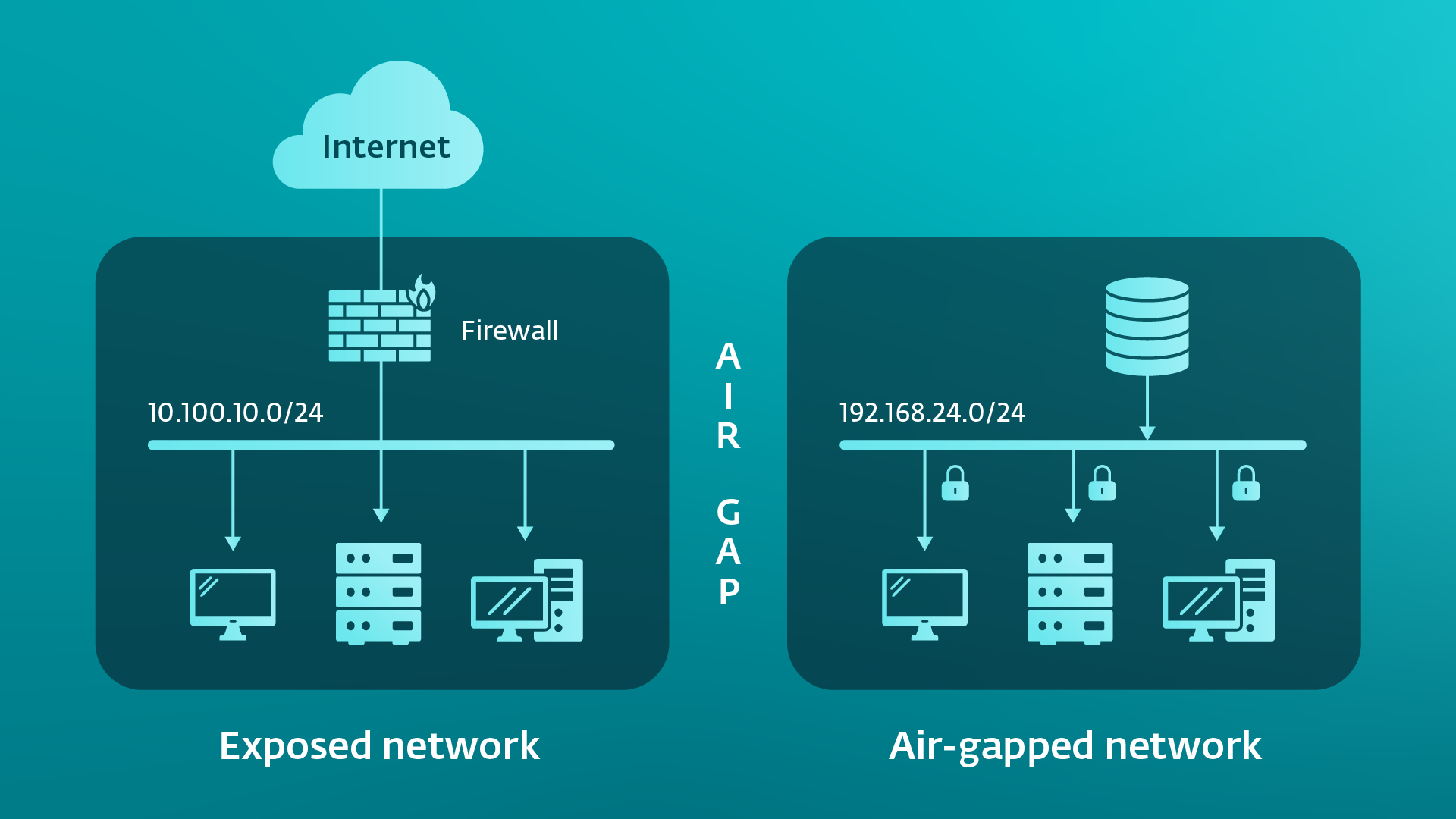
What is network segmentation?Segmentation relies on dividing networks into zones (typically enforced through controls like firewalls and demilitarized zones), to regulate and monitor traffic. Air gapping, by contrast, removes that interaction entirely, physically disconnecting systems from one another.
Air gapping in critical infrastructure: A boon or a challenge?
- Manufacturers and energy companies: Factory environments are becoming increasingly interconnected, driven by demand for enhanced supervisory visibility and control. This has led to the widespread enablement of remote OT management, whether through internal IT integration or third‑party access, expanding operational flexibility, but also introducing additional exposure pathways. This is even more true in the energy sector, due to its greater scale and complexity.
- Transportation: Rail systems, including signaling and control, are connected for more than operational reasons—safety factors are involved. This is true also in the maritime industry, where container cranes, terminal operating systems, and systems are either automated or effectively monitored and integrated via IT. Traffic systems also apply here (e.g., highway monitoring, tunnel controls, and etc.).
- Cities and utilities: The smarter our cities get, the more exposed they are. Public infrastructure (utilities), environmental systems (flood control) and surveillance (CCTV cameras) are now also centrally managed and remotely accessible, eroding the isolation they once relied on.
- ICT services: As regulators zero in on supply-chain attacks, the exposure of IT service providers comes into the spotlight. The connectedness of ICT services with any critical actor exposes them, potentially acting as a jumping-off point for attacks.
Physical air gaps
Can air-gapped systems be hacked?
One could argue that USB‑based compromise is not strictly a consequence of partial air gaps, but of air‑gapped environments in general. Even fully isolated systems typically depend on removable media for data transfer.
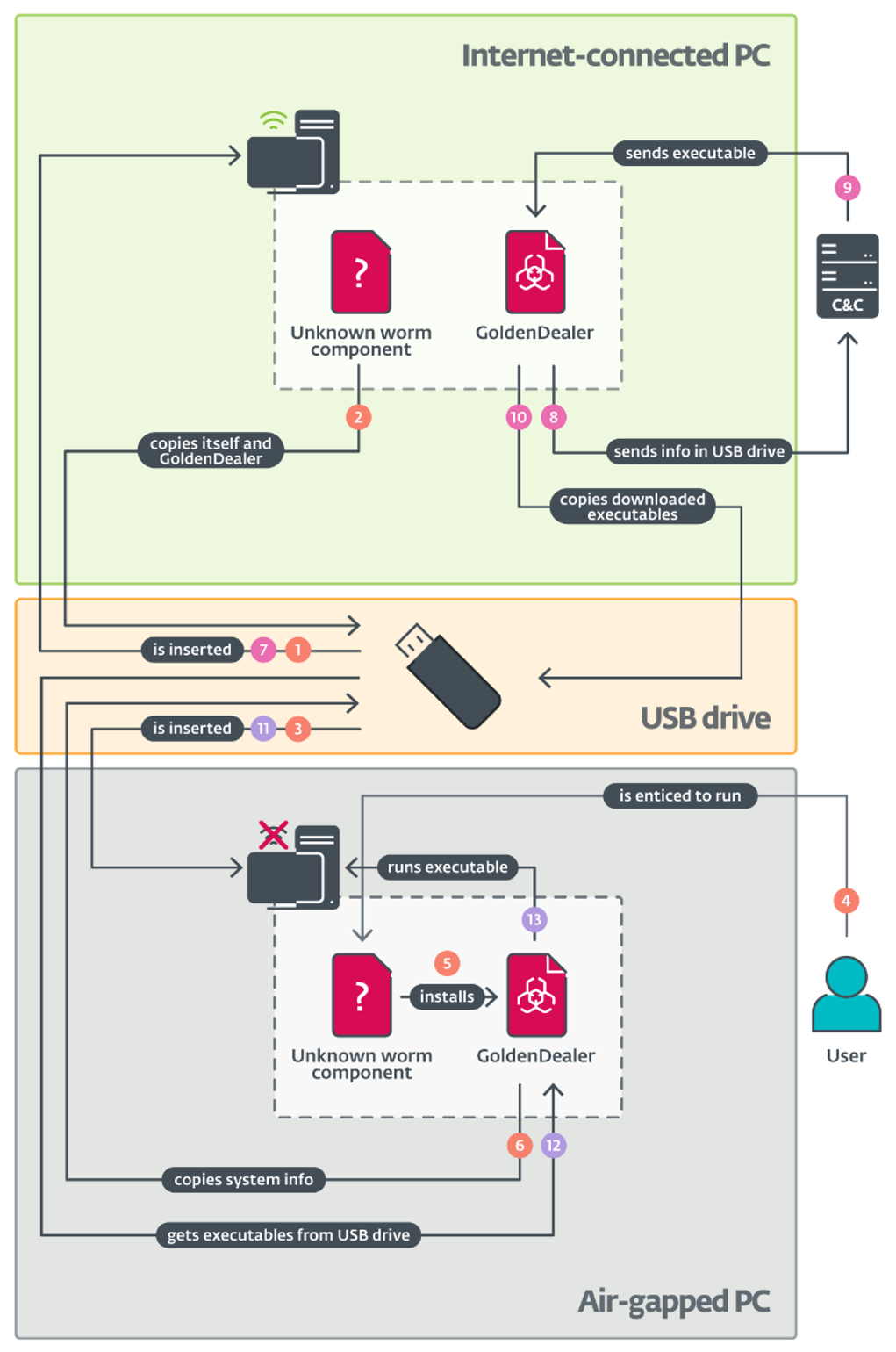
ESET Research: The case of GoldenJackal bridging air gaps
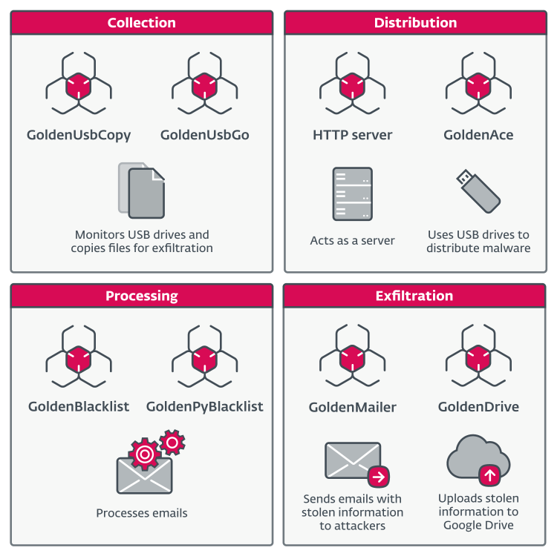
Further air gap-penetrating GoldenJackal activity
Best practices for air-gapped security: A layered, offline approach
- Offline cyber protection: Ensure that the environment can maintain uninterrupted security, data confidentiality, and operational continuity, even when fully isolated. This reduces dependence on external connectivity and eliminates exposure from network-based threats.
- On‑prem threat detonation: Analyze suspicious or unknown files locally rather than sending them externally. This protects sensitive data from leaving your environment while still enabling effective threat investigation.
- More secure update mechanisms: Avoid ad hoc methods like USB transfers or temporary unsecured connections. Instead, use controlled, purpose-built update processes to deliver patches and intelligence safely and on time.
- Flexible deployment: Choose solutions that operate reliably across diverse setups: from private networks to air‑gapped systems. This ensures consistent protection and reduces the risk of attackers exploiting environment-specific weaknesses.
- Secure data handling: Even isolated systems require backups or occasional file transfers. Establish tightly controlled processes for transferring and managing sensitive data. This prevents tampering, reduces the risk of unauthorized changes, and ensures trust in the integrity of your data.
- Planning for regulatory readiness: Keep sensitive data within isolated environments, and implement strong on-site controls like logging, monitoring, and reporting. This simplifies compliance efforts, strengthens auditability, and aligns data sovereignty requirements.
For organizations with complex infrastructure and strict isolation requirements, ESET PRIVATE Air-Gapped Solutions help deliver layered protection that supports secure operations across even the most restricted environments.
Conclusion
Next steps for building air-gapped resilienceExplore secure deployment options. Discover how ESET supports digital independence with flexible deployment options, including air-gapped environments in Gartner’s Europe Context: 2026 Magic QuadrantTM for Endpoint Protection report.Benchmark public-sector readiness. Explore the SANS 2026 Government Readiness Survey to gain data-driven insights into how government agencies are preparing for the evolving threat landscape.Talk to an expert. Speak with an ESET expert, and explore how to accelerate your cybersecurity readiness in complex ecosystems.

FAQ: About air gaps
What is an air-gapped system?
An air-gapped system is a device, network, or environment that is isolated from external networks, especially the internet, thereby reducing the risk of unauthorized access and of a resultant cyber-attack.
Who should air gap?
Critical infrastructure operators, such as energy providers, transportation entities, healthcare organizations, and utilities, use air gapping to protect operational technology (OT), backups, and sensitive data from cyber threats that could disrupt essential services.
Can hackers breach air-gapped networks?
Yes. While air-gapped environments are much harder to compromise, attackers can still use methods such as infected USB drives, compromised contractors, insider threats, or supply-chain attacks to gain access. Breaching an air-gapped network typically requires more time, resources, and sophistication though.
Is air gapping still relevant in the era of cloud and connected infrastructure?
Absolutely. As critical environments become more interconnected, air gapping remains a valuable security strategy for protecting high-value assets, backup repositories, and mission-critical systems. Modern organizations, should, however, combine air gapping with layered security controls, not only to balance resilience, compliance, and operational efficiency but also not to ensure that an air gap is not relied upon as the sole protection measure.